
Ask your compliance lead to approve a billboard and it takes a week.
Ask them who wrote the title tag on your Wyandotte location page and you will get a blank look, because in most dispensary businesses nobody has ever thought of a title tag as marketing copy.
It is the most publicly visible sentence you publish. It appears in front of every person searching for you, it persists for months without anyone rereading it, and on a chain one template pushes the same wording to every store at once.
Why regulators do not make the distinction you are making
The rules in every legal market describe advertising by what it does, not by where it sits. Marketing communications that promote a cannabis business are in scope, and no state programme carves out an exception for HTML. Two separate rulebooks reach that sentence, with different authors and different penalties, and telling the two apart is the first thing any compliance pass has to do.
That means your title tags, meta descriptions, image alt text, and Business Profile description are all inside the same boundary as a print advert. What differs is only that nobody in your organisation treats them that way.
The practical consequence is uncomfortable. Your riskiest copy is often the copy nobody reviewed, because the review process was built around the assets that cost money to produce.
The four claims that show up in title tags
Over the sites I have checked, the same four keep appearing.
Potency as a selling point. “Strongest flower in Michigan”, “Highest THC dispensary”, “Most potent carts”. Disclosure of THC percentage is required in most markets and perfectly fine. Framing potency as the reason to buy is promoting intoxication, and it is one of the most consistently enforced prohibitions across states.
Therapeutic outcomes. “Cannabis for anxiety in Ann Arbor”, “Pain relief dispensary”. These usually arrive on medical pages written with genuine care, which makes them harder to spot in an audit because nobody flags a page that is trying to help.
Price inducements. “Cheapest weed in Detroit”, “Daily deals”, “$5 prerolls”. Discount and inducement advertising is the most variable area between states, which is precisely why it should not be baked into a template that ships to every market you operate in.
Youth-adjacent product framing. Candy comparisons and sweet-styled naming that arrived from a strain name rather than from a marketing decision. This one is the most defensible and the least defensible at once: the cultivar name is real, and several states have acted on exactly that naming.
Why chains get this wrong at scale
A single store writes one title, somebody reads it, it is fine.
A chain builds a location page template with a title pattern, then ships it to forty stores. If the pattern contains a claim, forty pages carry it, and they all carry it identically, which makes the whole thing trivially easy to find.
That is the part worth sitting with. A regulator or a competitor does not have to audit your site page by page. A single site: search on your domain with a phrase like “strongest” returns every instance in one screen.
I mapped a chain’s titles and found all thirty-three location pages used the same seven-word pattern with only the city changed.
Google had rewritten twenty-eight of them.
The team had spent a quarter tuning titles that almost nobody was ever shown, and the five that survived carried a potency phrase nobody had reviewed since the site launched.
Two problems in one finding. The compliance exposure sat on the pages Google kept. The wasted effort sat on the pages Google replaced.
Titles are cut by pixels, not by characters
This is the technical half, and it matters because the compliance half competes for the same space.
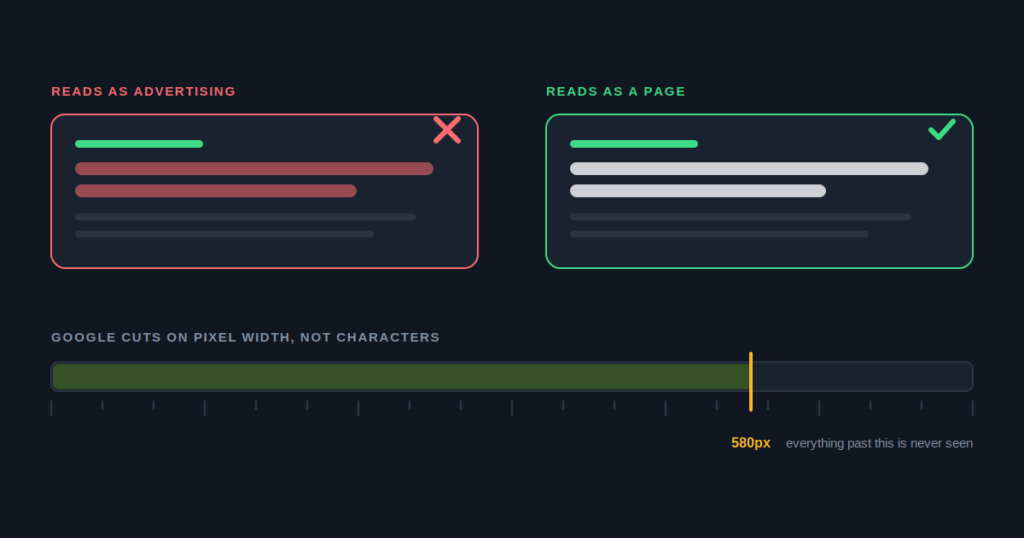
Google truncates at roughly 580 pixels on desktop and 490 on mobile. Character counts are a rough proxy, and a poor one, because letters have different widths. A title full of capital letters, Ms and Ws fits considerably less than one full of lowercase Is and Ls at the same character count.
The reason this connects to compliance is budget. Every pixel spent on “Best THC Deals” is a pixel not spent on the neighbourhood term that would have earned the click. The claim is both a risk and an opportunity cost, which is a rare combination and a useful argument when somebody defends it.
Preview and check in the same pass
The SERP snippet preview measures your title in pixels the way Google truncates it, runs the wording through cannabis compliance rules, and flags where multiple location titles share the same pattern.
What a location page title should contain
Three parts, in this order.
Category and place first. The term people actually search, plus the town. “Cannabis dispensary in Ann Arbor” rather than anything cleverer.
Then the differentiator. A neighbourhood, a district, a landmark. Something no other store of yours could claim, which is what stops your own pages competing with each other.
Brand last. It will sometimes be truncated, and that is the right thing to lose. Somebody searching your brand name will find you regardless; somebody searching a category and a neighbourhood is the reader you are writing for.
Nothing in that structure makes a claim, which means it needs no review beyond a spelling check.
How to audit yours in twenty minutes
1. Export every title on the site. Crawl it and pull the title column. If you do not have a crawler, Search Console’s Pages report plus a manual check of your templates covers most of it.
2. Search that export for the four claim types. Potency words: strongest, highest, most potent, THC percentage framed as a benefit. Therapeutic words: relief, treats, helps, cures, anxiety, pain, sleep. Price words: cheapest, deals, discount, sale, and currency symbols. Youth words: candy, gummy framed as sweets, cereal, and cartoon references.
3. Sort by the first six words to find the pattern. If dozens share an opening, you have a template. Fix the template rather than the pages, because fixing pages one by one on a chain guarantees the next build reintroduces it.
4. Check what Google is actually showing. Search a few of your own pages and compare the displayed title to the one you wrote. Where they differ, Google rewrote yours, which is a signal that the original was stuffed, duplicated, or disconnected from the page.
That last step is the one most people skip and it changes the priority order. There is no point rewriting a title Google has already replaced. Fix the ones being shown first.
Do not put a disclaimer in the title tag.
Adding “21+” or “For adults only” to a title feels responsible and does nothing useful. It consumes pixel budget, it does not satisfy any disclosure requirement on its own, and the requirement it is trying to meet belongs on the page and in the profile, not in a search snippet.
Write a title that makes no claim, and put the disclosures where they are actually required.
Getting this into your process
The fix is not a one-off audit. It is one line added to whoever ships pages.
Add titles and meta descriptions to whatever your compliance review already covers. If a print advert needs sign-off, so does the sentence appearing in front of every searcher in your market. This costs nothing and closes the largest unreviewed surface you have.
Review the template, not the instances. On a chain, a title is written once and shipped forty times. Reviewing forty pages is work; reviewing one pattern is a conversation.
Recheck after every site build. Titles are regenerated during migrations and redesigns, usually from a formula somebody wrote quickly on a Friday. The claim you removed last year comes back with the new theme.
The wider point
Most dispensary operators treat compliance as a packaging and paid media problem, then apply none of it to the website.
Regulators do not draw that line. Your location pages, product descriptions, blog posts, alt text, title tags, and profile description are all marketing, and the one nobody reviews is the one most likely to carry something you would not have approved.
Title tags are the sharpest example because they are simultaneously the most visible copy you publish and the least supervised. That combination is worth twenty minutes of somebody’s afternoon.
If you take one thing away
Export your titles today and search them for four words: strongest, cheapest, relief, and candy. Whatever comes back has been in front of your entire market for months.