
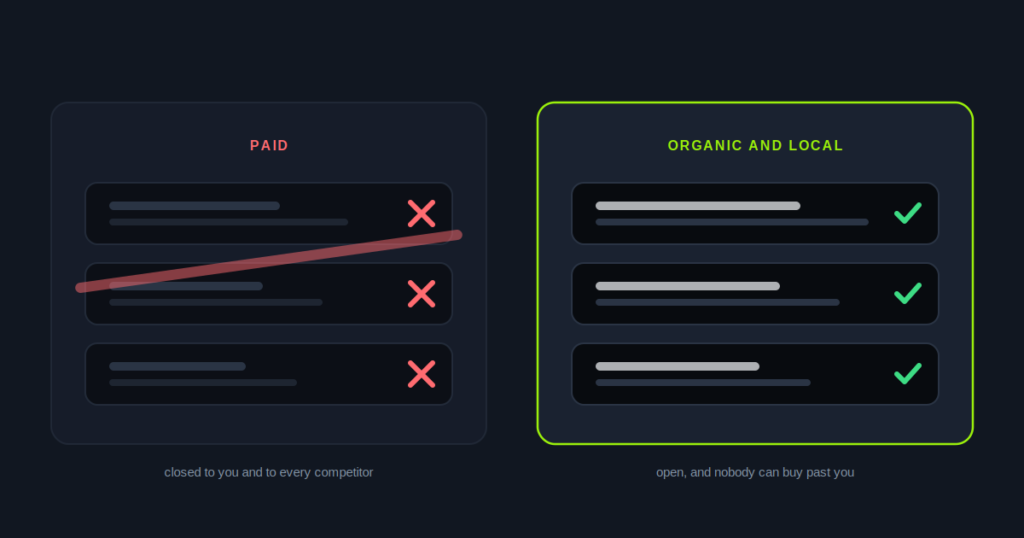
Google prohibits cannabis advertising. Meta does the same. So does most of the programmatic ecosystem, and the platforms that will take your money tend to have audiences that do not justify the spend.
For most retailers this would be catastrophic. Paid search is how an ordinary business compensates for a slow site, thin content, or a competitor with better rankings. You buy the position while you fix the underlying thing, or instead of fixing it.
You do not have that option. Neither does anybody you are competing with, and the second half of that sentence is the part worth thinking about properly.
What the restriction actually changes
In a normal category, organic search is one channel among several. It supports paid, it fills gaps, and a weakness in it is survivable because budget can cover the shortfall.
In cannabis retail, organic and local search are the acquisition strategy. There is no second lever.
That has three consequences that shape everything else.
Technical faults are not inconveniences, they are outages. An invisible menu on an ordinary ecommerce site costs you some organic revenue while paid search keeps the lights on. Here it costs you the channel. This is why a menu Google cannot read is the single most expensive fault in the industry rather than a technical nuisance.
Compounding matters more than it does elsewhere. Paid traffic stops when the budget stops. Organic visibility accumulates, and in a market where nobody can buy their way past you, the accumulation is the moat.
Competitors cannot outspend you. They can out-work you, out-write you, and out-organise you. They cannot simply pay more and take the position. That is a genuinely unusual competitive environment and it favours whoever is more patient.
What survives the restriction
The channels that remain are narrower than most marketers are used to, and they are more durable.
Organic search. Category and product demand, guides, and the informational searches that precede a first visit. Nobody is bidding against you, which means position one costs effort rather than money, and it stays yours once you have it.
Local search and the map pack. For a dispensary this is the closest thing to a queue outside the door. Somebody searching with proximity intent is usually deciding where to drive in the next twenty minutes, and the profile decides that result rather than the page.
Email, where it is permitted. Rules vary by state and it needs handling carefully, but a list of people who have already bought from you is an asset nobody can restrict from the outside.
Menu platform placement. Weedmaps and similar carry real intent and real cost. They work, they are a rental rather than an asset, and the visibility stops the day you stop paying. Worth using and worth being clear-eyed about.
Word of mouth and community presence. Difficult to measure and disproportionately powerful in a category where customers ask each other rather than searching, particularly for first-time buyers.
The sequencing this forces
When you have one channel, the order of work stops being a preference and becomes arithmetic.
1. Delivery first. Can Google read the page at all? Menu rendering, age gate behaviour, indexability, crawl budget. None of the later work returns anything if this layer is broken, and all of it is invisible from a browser.
2. Local second. Business Profiles for every store, citations, reviews, and location pages built from real store facts. This is where the highest-intent searches land, and it moves faster than organic does.
3. Content third. Written for the questions customers ask before they buy, published on a schedule you can sustain. This compounds, which means starting it late costs more than starting it small.
4. Links last, and earned. Industry sources, local press, genuine relationships. Never bought, because an unnatural links action takes every store on the same day, and in this industry the temptation to buy is exactly why the enforcement is attentive. The five sources that actually produce links for a dispensary are the practical version of that paragraph.
Teams get this order wrong in a predictable way: they commission content first, because content is easy to buy and easy to see. The order the work is actually scoped in exists for that reason. Then it lands on a site Google cannot fully read, and a quarter of budget produces nothing anyone can point at.
Where the money should go instead
If you were running paid search, a meaningful share of budget would be going to bids. That money still exists. It should be going somewhere.
Fixing delivery. Usually a development cost rather than a marketing one, and usually the highest-return line item on the list. A menu integration change is a fixed cost that improves every page permanently.
Store-level content gathering. Not writing, gathering. Somebody spending a week on phone calls collecting what makes each store different is the input that makes location pages work, and it is the step that gets skipped because it does not look like marketing.
Review generation. Systematic, in-store, ongoing. It is the strongest lever on local prominence and it costs process rather than budget.
Someone owning the profiles. One named person, not an agency and not a rota. Most suspensions trace back to a profile with no owner.
The uncomfortable part
The restriction is not actually an advantage. I want to be honest about that rather than sell you a reframe.
It removes a lever you would sometimes genuinely need. Opening a new store with no organic history is harder without paid search. Recovering from a bad quarter is slower. Testing messaging is harder when you cannot buy traffic to test it on.
What is true is narrower: the restriction applies to everyone, so it changes what winning requires rather than making winning harder. In an open category, the operator with the biggest budget can hold a position they have not earned. Here they cannot, and the operator who does the unglamorous work ends up in front of them.
That is worth knowing mainly because it changes what you should be impatient about. Being impatient about content velocity is reasonable. Being impatient about the technical foundation is how a year gets wasted.
A chain I worked with had spent most of a year on a content programme before anyone looked at delivery.
The writing was good. The strategy was sound. The menu was an iframe and the age gate was a server-side redirect, so a large part of the site was returning almost nothing to the crawler.
They had not been sold badly. They had simply been given the order of work that makes sense in an industry where paid search exists.
Do not try to find a way around the ad restriction.
Every few months somebody offers a workaround: a CBD-only landing page that funnels to the dispensary, a lifestyle brand account, an intermediary domain. These get accounts banned rather than pages rejected, and a banned advertising account is considerably harder to recover than a rejected advert.
The channel is closed. Building on the assumption that it is closed is the position that survives.
What to do first
If you take nothing else from this: find out whether Google can read your site before you spend anything on making it better.
That is one afternoon of checking and it determines whether the next quarter of work returns anything at all. It is also the question almost nobody asks, because a site that looks fine in a browser feels like a site that is fine.
Everything downstream, the content, the local work, the links, is compounding effort. Compounding effort on a broken foundation compounds to nothing.
If you take one thing away
Your competitors cannot outspend you here. They can only out-work you, so the order you work in decides more than the budget does.