
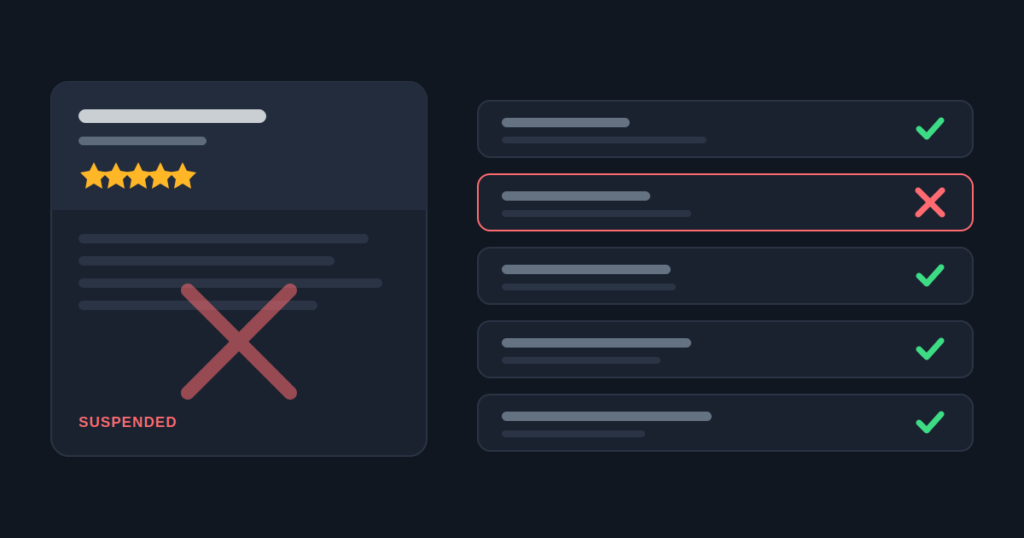
A suspension almost never happens on the day something goes wrong.
The profile is edited in March. It is suspended in June. By then whoever made the change has moved on to other work, the marketing calendar has turned over twice, and nobody connects the two events. So the team starts appealing without knowing what they are appealing about, which is the fastest route to a permanent problem.
This matters more for a dispensary than for almost any other business, because the Business Profile is not a supporting channel for you. Paid search is closed, so the map pack carries the searches where somebody is deciding where to drive in the next twenty minutes. A suspended profile does not reduce your visibility. It removes you from the moment of purchase.
Here is what actually causes it, in the order I encounter it.
1. An address that does not qualify
This is the most common cause by a wide margin, and the most misunderstood.
Google requires a real, staffed location that a customer can walk into during your stated hours. Virtual offices fail. Coworking desks fail. A shared suite where you are one of several businesses at the same door usually fails. So does a licensed unit you hold but have not opened yet, and that last one catches good operators who are simply trying to be ready.
The uncomfortable version of this problem is a fulfilment or delivery-only operation. If there is no storefront a customer can enter, the eligibility question is genuinely difficult, and no amount of appealing will change the underlying fact. Some operators in that position are better served by putting their effort into organic local pages than into fighting for a listing that does not qualify.
Best fix: confirm the address passes the walk-in test before you do anything else. Photograph the entrance with permanent signage visible, and be ready to film a continuous walkthrough from the street sign to the counter. Video verification is requested for this category more often than for most, and having it ready shortens everything that follows.
2. Keywords or a city added to the business name
Every local marketer has been tempted by this, and it does work briefly, which is exactly why it persists.
Google compares your profile name against the sign on your building. “Green Leaf” is your name. “Green Leaf Dispensary Ann Arbor” is not, unless that full string is genuinely on the front of the premises.
What makes this more dangerous than most violations is that it is enforced socially as well as algorithmically. Competitors file these reports actively, and in a licensed market where every operator knows the others, somebody is watching your listing.
Best fix: match the signage exactly, and put the descriptive terms where they belong. The category field, the description, and your location page can all carry “dispensary in Ann Arbor” without any risk at all. The name field cannot.
3. Promotions in the description or in posts
Your profile describes a business. It does not sell products.
The moment prices, discounts, deals, or potency claims appear in the description or in Google Posts, the listing moves from describing a licensed retailer to promoting restricted goods. That is a different thing under Google’s policies, and it is assessed differently.
This is the most preventable of the five, and it is usually caused by process rather than by ignorance. A new marketing hire treats the profile like a social channel, because on every other account they have managed, it was one.
Best fix: write the description once, about the business rather than the inventory, and lock it. Then decide explicitly whether you use Google Posts at all. Many chains I work with have concluded the upside is not worth the exposure, and post nothing. That is a defensible position rather than a lazy one.
4. Cannabis products added to the listing
Google product listings, ordering links, and menu integrations for restricted goods put the entire profile at risk rather than just the offending item.
Operators rarely do this deliberately. It usually arrives through a menu platform integration or a listing management plugin that pushes products to every connected channel by default, because it was built for ordinary retail where that is a useful feature.
Best fix: audit what your integrations are actually syncing, today, and turn off product push to Google specifically. Then check quarterly, because these tools add channels in updates.
5. Listing a store before it opens
A profile created ahead of opening, to start building visibility early, fails the staffed premises test on the day it is reviewed.
I understand the instinct completely. Local visibility takes time to build and opening day is the worst possible moment to start. But a suspension in month one is a considerably worse start than a listing created in week one of trading.
Best fix: create the profile when you can genuinely receive a customer. Use the run-up to build the location page, gather citations, and get your licence and signage documentation in order, so that verification is fast once you are eligible.
Check your exposure in about two minutes
The suspension risk checker asks twelve questions weighted by what actually causes cannabis listings to be pulled, and tells you which of your answers is the one to deal with first.
Run the GBP suspension risk checker
What it looks like on a real account
A client lost a listing the week a new manager added a weekly deal to the profile description.
It came back, but the store spent nineteen days out of the map pack, and that location took most of its walk-in traffic from exactly there.
Nothing about the profile had been wrong for the previous two years. One person, doing what looked like their job, on a channel nobody had written a rule for.
The lesson is not that the manager was careless. It is that the profile had no owner and no rule, so the first person to treat it as a marketing channel did. What belongs on a dispensary profile, and how one earns its map pack place to begin with, is the same subject from the other side.
What to do when it has already happened
The instinct is to appeal immediately. Resist it. Every rejection builds a record that makes the next review slower and more sceptical, and there is a point at which a reviewer stops reading carefully.
1. Stop editing the profile. Any further changes while a review is open look like tampering, and they make it harder to argue that the listing is now correct. Freeze it.
2. Find the trigger before you write anything. Open the change history and go back at least ninety days, not thirty. Ask who has had access, including former agencies and the platform vendors your integrations connect to. In the majority of cases the cause is sitting plainly in that log.
3. Fix the trigger and let the fix settle. Appealing before the fix is live is the single most common reason a first appeal fails. If the name was padded, correct it. If the description carried a promotion, rewrite it. If products were syncing, disconnect the integration rather than deleting individual items.
4. Gather evidence in the trading name. Your state licence, dated exterior photographs showing permanent signage with the business name clearly legible, and a utility bill or lease in the same name as the profile. Mismatched names between the licence and the listing cause more second-round rejections than anything else.
5. Prepare for video verification. For this category it is increasingly the default rather than the exception. Have someone ready to film one unbroken walkthrough: the street, the exterior signage, the entrance, the interior, and any equipment or stock that shows the business is genuinely operating.
6. Submit one appeal, then wait. State what was wrong, what you changed, and when. No argument, no history of how unfair it feels, no third submission because the first is taking too long.
Nobody outside Google can tell you a timeline, and anyone quoting one is guessing. What you control is whether the submission is worth reviewing.
Do not create a second profile while the first is suspended.
It is the most tempting move available and it makes everything worse. Duplicate listings for the same business are a separate violation, they complicate the original case, and they can turn a recoverable suspension into a permanent one.
The prevention that costs nothing
Almost every case I see traces back to the same structural gap: the profile has no owner.
Give one named person the primary owner role, not an agency and not a shared login. If a former supplier still holds primary ownership, recover it today rather than when something breaks, because you cannot act on your own appeal while somebody else holds that role, and chasing a former agency for access while your store is off the map is a bad position to be in.
Write down what may and may not go on the profile, in one paragraph, and give it to whoever manages marketing. It should say: no prices, no discounts, no potency, no product listings, and the name stays exactly as it is. That paragraph would have prevented four of the five triggers above.
Screenshot your profile quarterly. When something changes and nobody remembers what it looked like before, a dated screenshot turns a week of archaeology into two minutes.
If you take one thing away
Find the trigger before you appeal. An appeal submitted before the fix is live does not just fail, it makes the next one harder.